Free PDF The Cash Nexus: Money and Power in the Modern World, 1700-2000, by Niall Ferguson
Guide The Cash Nexus: Money And Power In The Modern World, 1700-2000, By Niall Ferguson will certainly still offer you good worth if you do it well. Completing the book The Cash Nexus: Money And Power In The Modern World, 1700-2000, By Niall Ferguson to read will certainly not end up being the only objective. The objective is by getting the positive worth from the book till the end of guide. This is why; you have to learn more while reading this The Cash Nexus: Money And Power In The Modern World, 1700-2000, By Niall Ferguson This is not only how fast you review a publication and also not just has the amount of you finished guides; it is about just what you have actually acquired from guides.
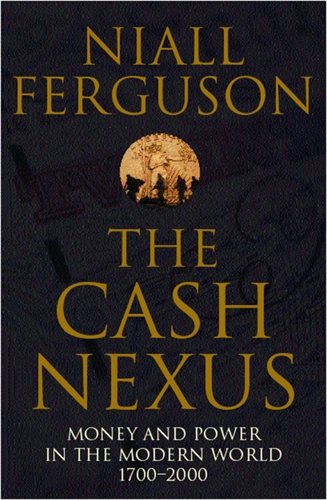
The Cash Nexus: Money and Power in the Modern World, 1700-2000, by Niall Ferguson

Free PDF The Cash Nexus: Money and Power in the Modern World, 1700-2000, by Niall Ferguson
The Cash Nexus: Money And Power In The Modern World, 1700-2000, By Niall Ferguson. Pleased reading! This is just what we desire to state to you that love reading so considerably. Exactly what regarding you that claim that reading are only commitment? Don't bother, reading practice must be begun from some certain factors. Among them is reviewing by obligation. As what we desire to provide right here, the book qualified The Cash Nexus: Money And Power In The Modern World, 1700-2000, By Niall Ferguson is not kind of required book. You can enjoy this book The Cash Nexus: Money And Power In The Modern World, 1700-2000, By Niall Ferguson to check out.
How can? Do you assume that you do not require enough time to go with purchasing e-book The Cash Nexus: Money And Power In The Modern World, 1700-2000, By Niall Ferguson Don't bother! Just rest on your seat. Open your gadget or computer and also be online. You could open up or check out the link download that we gave to obtain this The Cash Nexus: Money And Power In The Modern World, 1700-2000, By Niall Ferguson By through this, you could obtain the online publication The Cash Nexus: Money And Power In The Modern World, 1700-2000, By Niall Ferguson Reviewing the publication The Cash Nexus: Money And Power In The Modern World, 1700-2000, By Niall Ferguson by on-line could be truly done quickly by saving it in your computer and also device. So, you could continue each time you have free time.
Reviewing guide The Cash Nexus: Money And Power In The Modern World, 1700-2000, By Niall Ferguson by online could be likewise done conveniently every where you are. It seems that hesitating the bus on the shelter, waiting the list for line, or other locations feasible. This The Cash Nexus: Money And Power In The Modern World, 1700-2000, By Niall Ferguson can accompany you during that time. It will not make you really feel bored. Besides, this method will likewise enhance your life high quality.
So, merely be below, discover the e-book The Cash Nexus: Money And Power In The Modern World, 1700-2000, By Niall Ferguson now and also check out that quickly. Be the initial to review this e-book The Cash Nexus: Money And Power In The Modern World, 1700-2000, By Niall Ferguson by downloading in the web link. We have some other books to review in this web site. So, you could locate them likewise effortlessly. Well, now we have actually done to supply you the very best publication to read today, this The Cash Nexus: Money And Power In The Modern World, 1700-2000, By Niall Ferguson is truly ideal for you. Never ever disregard that you need this publication The Cash Nexus: Money And Power In The Modern World, 1700-2000, By Niall Ferguson to make far better life. On the internet publication The Cash Nexus: Money And Power In The Modern World, 1700-2000, By Niall Ferguson will actually offer very easy of every little thing to review and take the benefits.
Modern history shows that a nation's success largely depends on the way it manages its money. In times of war, finance has been just as crucial to victory as firepower. But where do money and politics meet? Starting in 1700 and ending at the present day, Niall Ferguson offers a bold and dazzling analysis of the evolution of today's economic and political landscape. Far from being driven by the profit motive alone, out recent history, as Ferguson makes clear, has also been made by potent and often conflicting human impulses - sex, violence and the desire for power.
- Sales Rank: #12539730 in Books
- Brand: imusti
- Published on: 2002-04-04
- Original language: English
- Number of items: 1
- Dimensions: 7.80" h x .98" w x 5.08" l, 1.01 pounds
- Binding: Paperback
- 552 pages
- Penguin Group CA
From Publishers Weekly
In a work that neatly marries the subjects of his previous books, Ferguson, who made his name with controversial popular histories of World War I (Pity of War, 1999) and the Rothschild banking empire (House of Rothschild, 1998), continues to challenge conventional wisdom. Here, he argues that the enormous expense of war, which forces governments into fiscal innovation, is the primary agent of financial change and its political repercussions, which sometimes include starting new wars. In Ferguson's view, political crises defined broadly to include those spurred by religion, law and culture cause both wars and financial disasters; the ensuing political outcomes determine the long-term economic fallout. Economic events, on the other hand, affect politics in indirect and unpredictable ways. Emphasizing the nuances and exceptions to his argument, he marshals economic statistics to support it, though he does not discuss alternative explanations for financial change. Despite frequent, jarring digressions into the minutiae of 1980s British politics and in praise of Thatcherism, the book is lucidly argued. But for a history that focuses so much on war, it includes little discussion of the military. Most controversially, Ferguson challenges the orthodox assumption that the world is headed toward a peaceful, prosperous and democratic global future. Economic success does not always lead to stability, he argues, and economic freedom is neither necessary for economic growth nor sufficient for political freedom. Nor, he warns, will economic globalization necessarily lead to greater economic or political cooperation. (Mar.) Forecast: This book will be more talked about than read, though it will attract serious readers. Like Ferguson's The Pity of War, its merits should outlive the controversy over its predictions.
Copyright 2001 Reed Business Information, Inc.
From Library Journal
In this scholarly tome, Ferguson (history, Jesus Coll., Oxford; The Pity of War) presents a heavily noted, high-level economic analysis of the impact of economic trends on political change. As he thoroughly analyzes the nexus between economics and politics, he delves deep into the complex relationship among economic principles and international war, political changes in major countries, social liberalization, and national demographics. He challenges the prevailing principles of well-known author Paul Kennedy (The Rise and Fall of the Great Powers), specifically that economic change is the prime mover of political change, contending rather that the conflicting impulses of sex, violence, and power are together more powerful than money. In the book's many dense chapters, Ferguson argues that political institutions have often dominated economic development, and he deftly integrates historical trends and eras, multiple economic principles and theory, as well as modern economic growth and development. This very complex economic analysis will well serve larger university libraries supporting higher-level study in economics, especially international economic theory. Dale Farris, Groves, TX
Copyright 2001 Reed Business Information, Inc.
From Booklist
Ferguson is a history fellow at Oxford's Jesus College and author of The House of Rothschild (1998-99), an exhaustively detailed, well-crafted chronicle of the banking dynasty. Today it is an oft-repeated notion that global corporations have supplanted national governments in setting policy and wielding influence. But Ferguson contends that throughout the last 300 years, economics has not been the primary driving force behind political and social change. He suggests that sex, violence, and power have been significant factors in shaping world events. He pulls together a boggling array of data and historical references to reach provocative conclusions, some of which seem to be contradicted by current events. For example, he predicts that individual national currencies will proliferate--even as more countries announce that they are switching from their own system to either the dollar or the euro. Time will tell! David Rouse
Copyright � American Library Association. All rights reserved
Most helpful customer reviews
0 of 0 people found the following review helpful.
Challenging but very worthwhile.
By Narut Ujnat
i have read a number of Niall Ferguson books and appreciate his books very much. He is an excellent writer and able to synthesize a information from economics, history, politics and philosophy.
This book,unlike some of his other books, is a serious attempt at economic history. By definition, then, most lay-readers without an economic background may be rightly intimidated by this work. As most serious economic texts are the book is dense and can be tough reading. This is not because Ferguson is a bad writer, but because the dismal science is a tough subject.
This book is essentially about how in terms of economics, wars and military conflicts have driven the world. Ferguson takes the years 1700-2000 and keeping in mind this book was first published in 2001 this makes eminent sense.
The book is supported by many facts and figures and may graphs. As far as books about economics og, I learned quite a bit and enjoyed the book. In its 450+ pages, this is a survey of many events in history, as well as economics, and it was always interesting. As I said, not a easy beach read, but if you want to read something challenging from which you will learn, this is a good place to start.
If you have little interest in economics or no background, I would recommend other Ferguson books, or Sowell's Basic Economics as a start.
However, this is a really good book and deserves to be read, irrespective if you agree or disagree with his thesis.
2 of 2 people found the following review helpful.
Kindle Formatting Poor
By S. P. Hayes
THIS IS A RATING ONLY OF THE KINDLE FORMATTING, NOT THE BOOK ITSELF. Until Amazon allows for a review specifically of the Kindle formatting or another score within a review, I am forced to score the book poorly. Though this isn't the worst book for formating I've read on the Kindle, it is the worst one I've paid for. I expect a difficult or unpleasant reading experience out of free e-books, but for one I pay more than $0.99 for I expect MORE. None of the end notes are hyperlinked forcing the interested reader to have to guess-navigate to and from the end notes. Worst of all, though, occurs in Chapter 12 where a sentence abruptly ends into a numbered list. "What, that train of thought doesn't make any sense. Oh well, maybe I just don't understand. Just carry-on.... wait, I've read this before." That's right. Someone must have accidentally COPIED-AND-PASTED select paragraphs inadvertently on two different occasions in the same chapter. Talk about losing the point AND the reader. Did this happen earlier when I was confused and just didn't know it. Don't waste your money on the overly priced Kindle Format until the publisher guarantees the format.
2 of 2 people found the following review helpful.
War as Investment
By M. T. Brouwer
This book is a fascinating read for everyone who is interested in the application of economic theory to world history. Reviewing and rejecting economic determinist theories like marxism, the political business cycle and imperial overstretch, Ferguson advances his own argument. It is war that brought us modern finance, bureaucracy and democracy. The outcome of war cannot be predicted with accuracy, but the nation that can finance it at least costs has a comparative advantage. Ferguson skillfully applies modern expectations theory to his historical account. He argues that military hegemony can spread good institutions around the globe as happened under British rule. You can disagree with his plea for benevolent imperialism in an age in which nations want to determine their own future. Moreover, it is questionable whether war `pays', since the costs of war exceeded revenues in most cases as Ferguson points out. But, this did not stop nations and groups from waging war.
The Cash Nexus: Money and Power in the Modern World, 1700-2000, by Niall Ferguson PDF
The Cash Nexus: Money and Power in the Modern World, 1700-2000, by Niall Ferguson EPub
The Cash Nexus: Money and Power in the Modern World, 1700-2000, by Niall Ferguson Doc
The Cash Nexus: Money and Power in the Modern World, 1700-2000, by Niall Ferguson iBooks
The Cash Nexus: Money and Power in the Modern World, 1700-2000, by Niall Ferguson rtf
The Cash Nexus: Money and Power in the Modern World, 1700-2000, by Niall Ferguson Mobipocket
The Cash Nexus: Money and Power in the Modern World, 1700-2000, by Niall Ferguson Kindle

Tidak ada komentar:
Posting Komentar